PDE5 inhibitors- the class of medication that includes sildenafil and tadalafil – are effective treatments for erectile dysfunction for the majority of men who use them appropriately. The word appropriately matters. How, when, and in what context these medications are taken significantly affects how well they work. Many men who conclude that ED medication is not working for them are actually using it in conditions that reduce its effectiveness.
This article covers what the clinical evidence says about the practical factors that affect PDE5 inhibitor performance – none of which require a higher dose or a different product.
Timing: the most commonly mismanaged factor
Sildenafil timing
Sildenafil typically begins to take effect 30 to 60 minutes after administration under optimal conditions. However, the medication does not produce an erection – it enhances the physiological response to sexual arousal. Taking sildenafil an hour before a situation where sexual arousal is present and possible is the intended use pattern.
A common error is taking sildenafil too far in advance – two or three hours before anticipated sexual activity – by which point some of the drug has already been metabolised. Another is taking it in a stressful or non-intimate context and expecting it to produce an effect without adequate arousal.
Tadalafil timing
Tadalafil’s longer half-life – with effects lasting up to 36 hours – gives significantly more flexibility. The 30 to 120-minute onset window still applies, but the broad duration means precise timing is much less critical. For men who find sildenafil’s narrow timing window stressful, tadalafil’s pharmacology is a genuine practical advantage.
For men prescribed daily low-dose tadalafil, timing is irrelevant – the consistent blood level means the medication is always active.
Food: why it matters more with sildenafil than tadalafil
This is one of the most clinically significant practical factors affecting sildenafil’s effectiveness and one of the most commonly overlooked.
Sildenafil is absorbed in the small intestine. A high-fat meal slows gastric emptying significantly – food remains in the stomach longer, and sildenafil is not released into the small intestine as quickly. Studies comparing sildenafil taken fasted versus taken after a high-fat meal show that the high-fat meal can delay peak plasma concentration by up to an hour and reduce the maximum concentration achieved.
In practical terms: taking sildenafil on a full stomach – particularly after a fatty meal – can reduce and delay its effect substantially. The medication is best taken at least two hours after a heavy meal, or before eating.
Tadalafil is significantly less affected by food. This is a pharmacokinetic difference between the two compounds that makes tadalafil more forgiving in real-world use.
Grapefruit and grapefruit juice inhibit an enzyme (CYP3A4) involved in sildenafil metabolism, which can increase drug levels unpredictably. Both should be avoided when taking sildenafil.
Alcohol: a more complex interaction than most assume
Moderate alcohol consumption and sildenafil are not absolutely contraindicated – but the interaction is more nuanced than simply being told to avoid alcohol.
Alcohol is a vasodilator – it widens blood vessels and lowers blood pressure. Sildenafil is also a vasodilator through its mechanism of action. The combination increases the blood pressure-lowering effect of both, which can cause dizziness, light-headedness, and flushing. At higher alcohol volumes, the risk of a meaningful blood pressure drop increases.
Alcohol also directly impairs erectile function independently of medication. It suppresses the central nervous system, reduces testosterone release, and impairs the neurological signals required for erection. Heavy alcohol consumption is one of the most reliable ways to reduce the effectiveness of PDE5 inhibitors regardless of dose.
Practical guidance: one to two units of alcohol is unlikely to significantly affect sildenafil or tadalafil. More than this increases both side effect risk and the likelihood of reduced medication effectiveness.
Psychological state and arousal
This factor is underweighted in most discussions of ED medication. PDE5 inhibitors work by amplifying the physiological response to sexual arousal. They do not override psychological barriers to arousal. If a man is anxious, distracted, or not genuinely aroused, the medication has limited biochemical signal to amplify.
Performance anxiety – the specific worry about whether the medication will work – is particularly counterproductive. The anticipatory anxiety generates cortisol and adrenaline, which work against the parasympathetic nervous system activity that arousal requires. Men who report that the medication does not work consistently often find that it works well in relaxed, low-pressure situations and less well when there is psychological pressure around the outcome.
This is not a reason to take a higher dose. It is a reason to consider whether addressing the psychological component – through open communication with a partner, or professional psychosexual support – might be more useful than medication adjustment.
Lifestyle factors with genuine evidence
Smoking
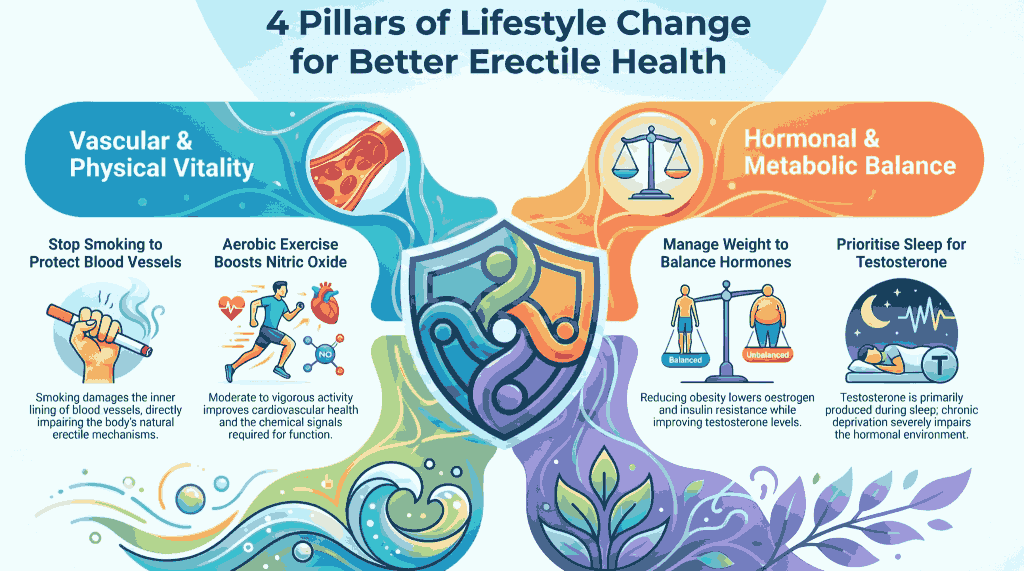
Smoking causes endothelial dysfunction – damage to the inner lining of blood vessels – which directly impairs the vascular mechanism that PDE5 inhibitors support. Smokers have a significantly higher prevalence of erectile dysfunction, and cessation has documented positive effects on erectile function. For men who smoke and use ED medication, cessation is one of the highest-impact interventions available.
Physical activity
Regular aerobic exercise is associated with improved erectile function through multiple mechanisms: improved cardiovascular health, increased nitric oxide production, reduced obesity-related hormonal disruption, and improved psychological wellbeing. A meta-analysis of studies on exercise and ED found that moderate to vigorous aerobic exercise produced clinically significant improvements in erectile function scores.
Body weight
Obesity is associated with lower testosterone, elevated oestrogen, insulin resistance, and cardiovascular risk factors – all of which impair erectile function independently of medication. Weight loss in overweight men with ED has been shown to produce meaningful improvements in erectile function, sometimes reducing the need for medication.
Sleep
Testosterone is primarily produced during sleep. Chronic sleep deprivation reduces testosterone levels and impairs the hormonal environment that supports erectile function. Addressing sleep quality is rarely discussed in the context of ED management but has physiological relevance.
When medication consistently does not work
If PDE5 inhibitors are not producing the expected effect despite correct use – appropriate timing, taken away from heavy meals, with minimal alcohol, in a context of adequate arousal – a GP review is the appropriate next step. Non-response can indicate:
- An underlying condition such as more severe vascular disease or low testosterone that requires direct management
- A medication interaction that is reducing the drug’s effectiveness
- A predominantly psychological cause that medication alone will not address
- A need to switch to a different PDE5 inhibitor – some men respond better to tadalafil than sildenafil, or vice versa
Frequently asked questions
Does it matter what time of day sildenafil is taken?
No – there is no time-of-day effect on sildenafil pharmacokinetics. What matters is the interval between taking the medication and sexual activity, and whether it is taken on an empty or full stomach.
Can you take sildenafil every day?
Sildenafil is generally used on demand rather than daily. Low-dose daily tadalafil is approved for daily use. Whether daily use of any ED medication is appropriate for an individual is a question for their prescribing doctor.
Does caffeine affect sildenafil?
There is no significant pharmacokinetic interaction between caffeine and sildenafil. However, high caffeine intake can increase anxiety and heart rate, which may counterproductively affect the conditions needed for the medication to work effectively.
Should ED medication be taken with water?
Standard tablets should be swallowed with a full glass of water. Adequate hydration supports absorption and reduces the likelihood of headache as a side effect.